

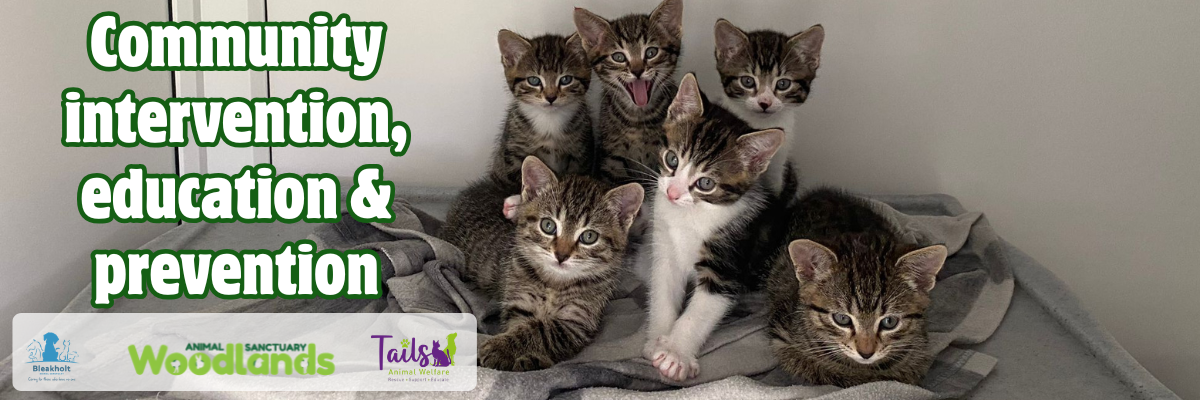
Helping communities. Preventing unwanted litters.
There’s a problem. And it’s getting worse.
Neutering rates across the UK are falling. According to Cats Protection’s annual CATS Report, the proportion of owned cats that are neutered has dropped from 88% in 2020 to 82% in 2025 - and the gap is widening.
What we’re seeing here locally in Lancashire and Merseyside...
The national picture is reflected in our own data, and in some areas, it’s considerably sharper.
Last summer, Woodlands Animal Sanctuary recorded an 88% increase in cat intake volume compared to the previous year. Across our full intake data, 47% more cats came through our doors than in prior years. Almost half of all cats we took in - 49% - were the result of unplanned litters.
These aren’t abstract statistics pulled out of thin air. They represent real animals that came into our care - kittens born into uncertainty, cats surrendered by families who didn’t plan for them and couldn’t cope.
This year alone we have attended record multi-cat rescues which were all down to out of control breeding. Most recently a single household with 26 cats - all descended from one un-neutered pet.
Caring for such volumes costs money. Prevention is the only sustainable answer.

What we’re doing about it
We can no longer just wait for the problem to land on our doorstep. Each year we are constantly looking at ways to increase funding to match increased demand, rescue volumes and costs.
Woodlands are now implementing a community education, intervention and prevention programme to reduce unwanted litters at source - targeting this support in the communities where the need is greatest.
Our programme:
Community neutering programme
We offer free cat neutering to households in specific streets and postcodes across West Lancashire. We don’t operate everywhere at once - we use data from our own intake records and local deprivation indicators to identify the areas where lack of access to neutering is causing the most harm.
When we identify a target area, we go in properly: door-to-door outreach, printed materials in plain language, and a dedicated booking line. We also provide general care advice, and food bank support in addition to neutering in order to further mitigate against abandonments.
Each round of the programme has a fixed number of operations available. When they’re gone, they’re gone - which creates genuine urgency and prevents waste.
Trap, neuter and release - for feral cats
Feral cats cannot be rehomed. They live in colonies, breed rapidly, and are largely invisible to conventional neutering programmes. Left unaddressed, a single unneutered female can be responsible for hundreds of descendants within just a few years.
Our trap, neuter and release (TNR) programme humanely traps feral cats, neuters them, and returns them to their territory. It’s the most effective method available for reducing feral colony numbers over time - and it’s entirely invisible to the cats and communities who benefit from it.
We identify feral colonies using local intelligence, reports from the public, and our own outreach work. If you know of a feral colony in your area, get in touch.
How we decided where we work...
We don’t spread ourselves thinly. Our programmes operate in specific streets and postcode areas at any given time, chosen using a combination of:
-
Our own intake data - tracking where surrendered and stray animals are coming from
-
Deprivation data and local intelligence about access to veterinary services
-
Reports from residents, community workers, and partner organisations
-
The location of known feral colonies
This approach means every operation we fund goes where it will make the most difference.


